

There are few disappointments in medicine as painful as not matching into residency.
After years of effort, sacrifice, exams, sleepless nights, applications, interviews, and hope, this moment can feel crushing. It can leave you questioning your worth, your future, and even your identity. For many, it feels like more than a professional setback. It feels personal.
But this moment, painful as it is, does not define the rest of your life.
Not matching is not proof that you are not smart enough, capable enough, or deserving enough. It is not the final word on your future in medicine. It is not the end of your dream.
It is a setback. A hard one. But it is also a turning point — a moment that asks you to pause, regroup, and rise again with more clarity, strategy, and strength.
Many excellent physicians have faced rejection before finding the path that ultimately shaped them into remarkable doctors. Sometimes the road changes before the purpose does.
Before doing anything else, acknowledge the pain.
You do not need to pretend you are fine. You do not need to hide your disappointment behind forced positivity. Not matching hurts, and it is okay to say so.
Give yourself permission to grieve. Speak to people you trust — family, friends, mentors, advisors, or colleagues who can remind you that one result does not erase years of discipline and sacrifice. Do not isolate yourself. This is the time to lean on people who see your value clearly, especially when you may not see it yourself.
A painful outcome deserves honesty before strategy.
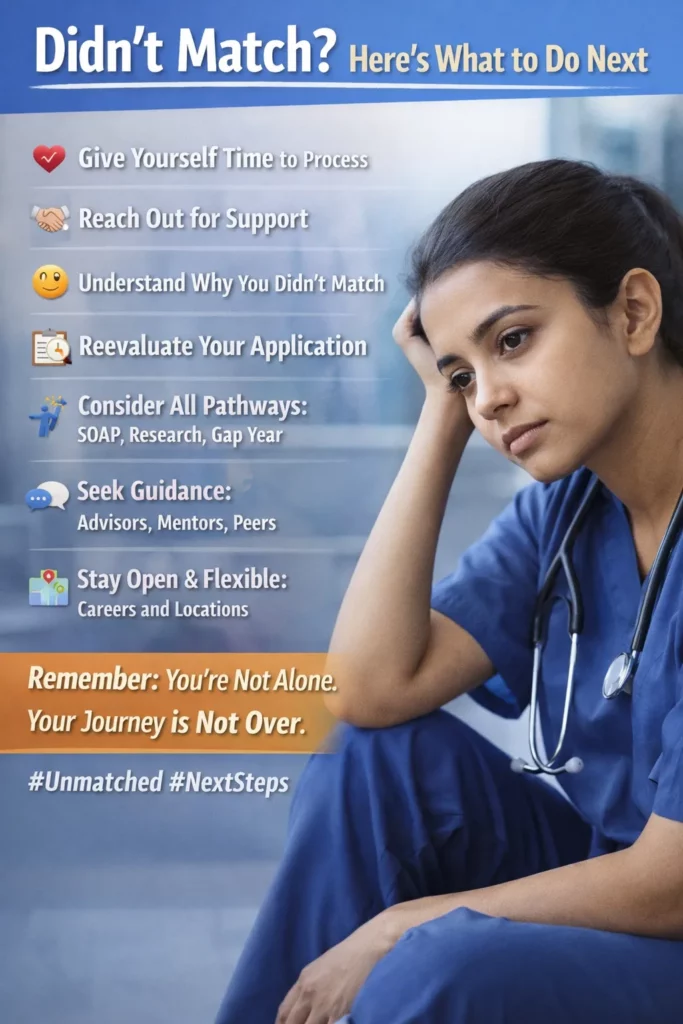
Once the initial shock begins to settle, the next question becomes: what now?
The answer is not to give up. The answer is to move forward deliberately.
There are immediate steps to consider, and there are longer-term steps that can strengthen both your application and your professional identity.
One of the most important immediate options is SOAP — the Supplemental Offer and Acceptance Program.
For eligible applicants, SOAP provides an opportunity to pursue unfilled residency positions during Match Week. It is fast-moving, emotionally intense, and highly time-sensitive, but for some applicants, it becomes a critical second chance.
If you are participating in SOAP, approach it with urgency and professionalism. Be available. Stay organized. Read communications carefully. Review programs thoughtfully but quickly. Speak with mentors who can help you think strategically. Be flexible about specialty, location, and pathway if appropriate.
SOAP may not lead to the exact position you initially imagined, but it may open a meaningful door. Sometimes, the opportunity that was not part of the original plan still leads to a fulfilling and successful career.
Whether or not SOAP works out, one of the most important things you can do is understand why you did not match.
This requires honest feedback, not vague reassurance.
Ask trusted mentors, faculty, advisors, or program leaders to critically review your application. Were there weaknesses in your board scores? Was your interview performance strong enough? Did your personal statement reflect your story well? Were your letters of recommendation detailed and enthusiastic? Did your clinical experiences demonstrate readiness? Was your specialty choice or geographic strategy too narrow?
Growth begins with clarity. Once you understand where the gaps were, you can begin addressing them meaningfully.
If you do not match, it is important not to drift away from medicine.
Remain connected to patient care in whatever constructive way is available to you. Depending on your circumstances, this may include observerships, externships, research roles with clinical exposure, volunteer work, assistant positions, or supervised clinical experiences.
Staying clinically engaged shows that your commitment to medicine remains active. It demonstrates discipline, maturity, and persistence. It also helps keep your knowledge fresh, your communication skills sharp, and your confidence intact.
Programs want to see that you remained close to the work, even during a difficult chapter.
A year that initially feels like a setback can become a year of meaningful academic growth.
Join research teams. Work on abstracts, case reports, review articles, quality improvement projects, posters, manuscripts, or presentations. If possible, publish. Even one or two solid scholarly contributions can strengthen your application and show that you remained productive and engaged.
Research does more than fill space on a CV. It reflects curiosity, resilience, discipline, and intellectual commitment. It shows that you kept moving forward instead of becoming passive in disappointment.
Reapplying successfully usually requires more than just resending the same application with minor edits.
You should review your entire professional presentation:
your CV, personal statement, letters of recommendation, interview skills, clinical experiences, research output, volunteer work, leadership roles, and overall narrative.
Ask yourself whether your application clearly shows growth, service, teachability, professionalism, and commitment. If not, strengthen it intentionally.
A stronger application is not simply a longer application. It is one that tells a more convincing story.
Strong letters matter.
If your previous letters were generic or written by people who did not know you well, look for opportunities to build meaningful relationships with faculty or supervisors who can write with specificity and conviction. The best letters come from those who have directly observed your work ethic, clinical judgment, professionalism, teamwork, and character.
A sincere, detailed letter can make a far greater impact than a prestigious name attached to a vague endorsement.
For some applicants, this season may be a valuable time to pursue additional education.
An MPH can deepen your understanding of epidemiology, public health, health equity, prevention, and outcomes. An MBA or training in Healthcare Management can strengthen leadership skills, systems thinking, operational understanding, and future administrative potential.
Other paths — such as clinical research, informatics, medical education, or quality improvement — can also be highly meaningful, depending on your goals.
The purpose is not to accumulate credentials for appearance alone. It is to use this time to grow in ways that genuinely strengthen your future.
Sometimes a candidate looks strong on paper but does not communicate effectively during interviews.
This is an area worth improving intentionally. Practice mock interviews. Refine how you tell your story. Prepare to explain setbacks honestly without sounding defeated. Learn how to speak with confidence, humility, and maturity.
Programs are not only evaluating what you have done. They are also assessing how you think, how you communicate, how you reflect, and how you carry yourself under pressure.
Keep learning.
Attend conferences. Participate in grand rounds. Read regularly. Stay aware of current clinical practices. Keep your mind in medicine and your identity anchored in growth. If possible, teach, mentor, tutor, or volunteer. Continued engagement matters.
Do not let this season become a silent gap. Let it become a visible chapter of perseverance and development.
This part is essential.
Do not let one outcome become your entire self-definition.
A match result is important, but it is not a complete measure of your intelligence, character, compassion, or potential. It reflects one cycle, one process, one moment in time — not your entire future.
Some of the most inspiring people in medicine were shaped not only by success but by how they responded to disappointment.
This moment can make you bitter, or it can make you stronger. It can make you retreat, or it can make you rebuild with greater wisdom.
Choose the second path.
If you did not match, hear this clearly:
This is not the end of your future.
You are still capable.
You are still needed.
You still have the power to become an outstanding physician.
Pause. Regroup. Rise again.
Use this season to reflect honestly, grow intentionally, and return stronger. Explore SOAP if you are eligible. Strengthen your clinical experience. Build research. Improve your application. Consider meaningful education, such as an MPH, an MBA, or a Healthcare Management degree. Seek mentors who tell you the truth and help you move forward. Healthcare IT, PA, and NP also remain alternatives.
Your path may look different from what you expected today. But different does not mean defeated.
Sometimes the most difficult chapter becomes the one that shapes your strength, clarifies your purpose, and prepares you for the work you were meant to do.
Your story is not over.
It is still unfolding.